Major infrastructure rehabilitation projects rarely begin with construction. They begin with data.
The North Outfall Sewer (NOS) Unit 10 rehabilitation project in Los Angeles was recently recognized as the 2025 Trenchless Technology Rehabilitation Project of the Year[1]. It is a perfect example of how high-quality inspection data enables successful engineering and construction outcomes.
While the award highlights the engineering and rehabilitation teams responsible for delivering the project, the success of the effort began much earlier, with the challenge of assessing the condition of a critical infrastructure component that could not be inspected using conventional methods.
For projects like this, better decisions require better data, delivered faster.
When Traditional Inspection Isn’t Enough
In aging infrastructure projects, the greatest risk often lies in what cannot be seen.
For the NOS Unit 10 project, the inspection team needed to document:
- Structural deterioration and corrosion
- Missing tile liners
- Debris accumulation affecting hydraulic capacity
- Pipe geometry and deformation
- Precise measurements for rehabilitation design
Standard video inspection alone could not provide the level of dimensional and structural insight required. Engineers needed a comprehensive understanding of the pipe’s geometry and condition to design a rehabilitation solution with confidence.
This is where advanced inspection technology made a difference.
Capturing Better Data with Profiler 3D
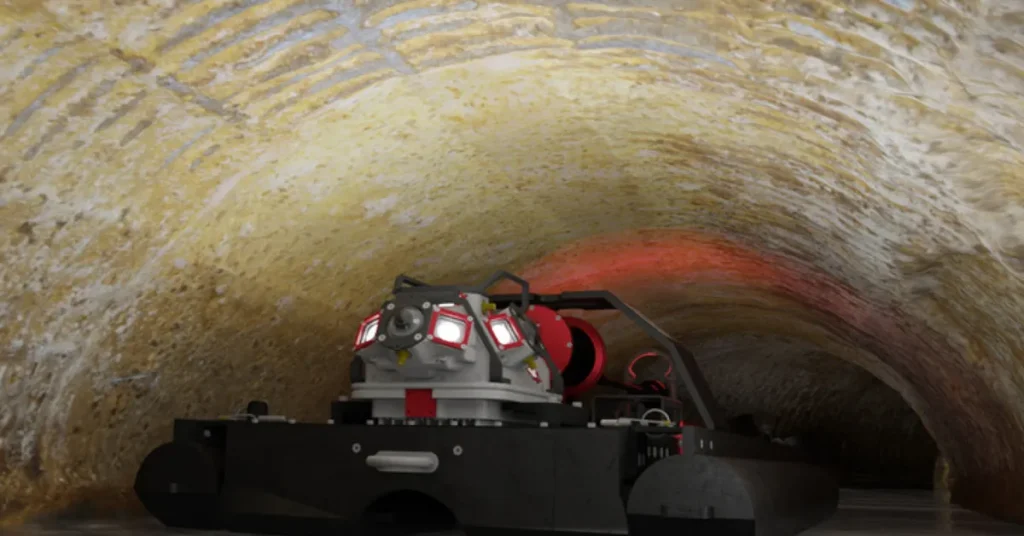
Using Profiler 3D, RedZone Robotics captured high-resolution inspection data that went far beyond traditional video. Profiler 3D combines advanced imaging with photogrammetric processing to transform inspection footage into measurable three-dimensional data.
Instead of simply viewing defects, engineers could:
- Measure pipe geometry with high accuracy
- Identify structural changes and deformation
- Quantify deterioration
- Visualize the pipe interior in a digital 3D model
In projects like NOS Unit 10, this level of insight is critical. Rehabilitation engineers must understand not just where deterioration exists, but how the pipe’s geometry and structural condition influence the design solution.
Through photogrammetry, the imagery was converted into a high-resolution 3D model of the pipeline, allowing engineers to perform virtual mandrel analysis, evaluate pipe geometry, and extract dimensional measurements needed for rehabilitation design.
Better Data Enables Better Infrastructure Decisions
Projects like this illustrate a critical shift occurring across infrastructure management. Inspection is no longer just about video documentation. Today, it’s about delivering accurate, actionable data that engineers can use immediately.
RedZone’s Better Data, Faster approach reflects this evolution:
Better Data
- Multi-sensor inspection technologies
- Quantitative measurement through photogrammetry
- High-resolution imaging and modeling
Faster Insights
- Rapid data processing
- Digital deliverables engineers can use immediately
- Faster decision-making for rehabilitation planning
By combining advanced inspection technology with scalable data processing, asset owners and engineers gain the clarity they need to move complex projects forward with confidence.
And that’s what Better Data, Faster is all about!
[1] North Outfall Sewer Unit 10 Rehabilitation — 2025 Trenchless Technology Rehabilitation Project of the Year
Published by Trenchless Technology Magazine
https://trenchlesstechnology.com/2025-trenchless-technology-rehabilitation-project-of-the-year/